


 Jan Thijs/Paramount+
The following contains spoilers for "Star Trek: Strange New Worlds" Season 4 Episode 1 "Valles Marineris."
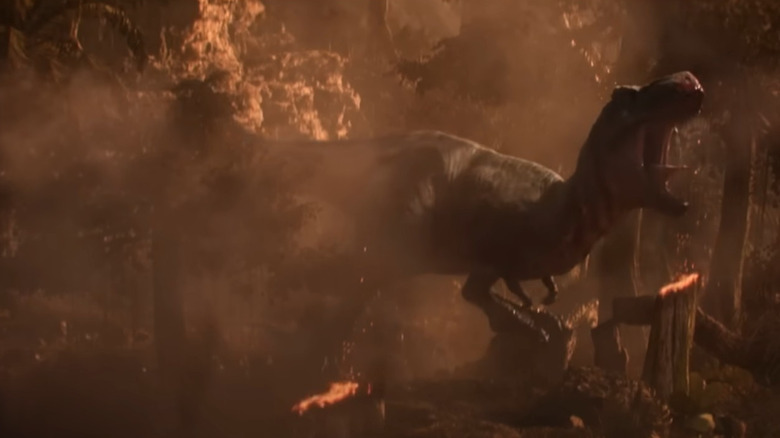
"Star Trek" has done many, many episodes involving time travel, but never before has the starship Enterprise gone back to the time of the dinosaurs. After all, no "Star Trek" series would've had the budget to render dinosaurs convincingly ... until now. The trailer for "Star Trek: Strange New Worlds" Season 4 showed a T-Rex roaring, and I have good news: This was from the season premiere!
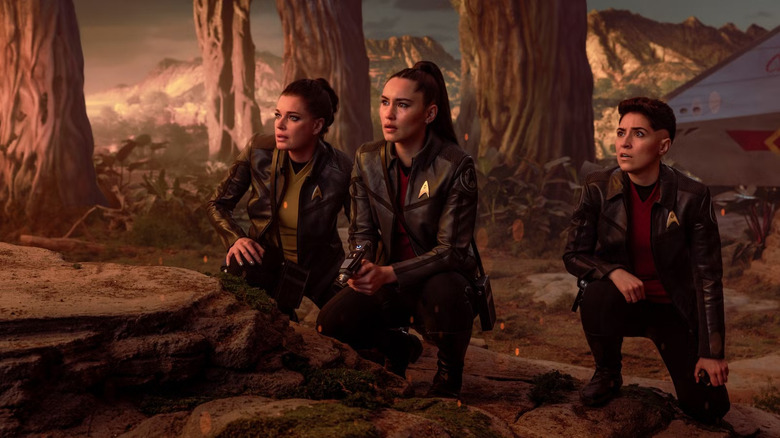
The Enterprise is caught in an "interstellar squall" that seemingly throws them into a distant solar system. Una (Rebecca Romijn), La'an (Christina Chong), and Ortegas (Melissa Navia) go down to one of the system's planets, and discover a large animal in their path, hidden behind trees. Then, the crew learns they're actually 65 million years in the past. The planet the away team landed on is prehistoric Earth, and the beast reveals itself to be a T-Rex.
It also turns out dinosaurs aren't the only life in the system. The Enterprise encounters a crew of Martians, who have an advanced civilization that there's no trace of in the 23rd century. In this ancient past, there also used to be another planet between Mars and Jupiter, and its insectoid inhabitants are waging war on the Martians. So, the Martians steal an antimatter cell from the Enterprise and destroy this fifth planet. We then see one enormous piece of planetary debris become the Chicxulub impactor, one of the largest asteroids to ever hit Earth, which caused the dinosaurs' mass extinction.
Captain Pike (Anson Mount) considers stopping the Martians, but at the last moment, he holds back and does nothing. After all, in the present there is no Martian race, and no planet between Mars and Jupiter.
 Paramount+
Pike and the Enterprise's dilemma is essentially the trolley problem. Stopping the Martians would mean rewriting 65 million years of history so humans never evolved. The temporal implications of that big a change are too big to comprehend, so Pike made the right call even if there was obvious self-interest.
The Enterprise crew take comfort in the fact that history unfolded the way it was meant to. The destruction of the system's fifth planet shifted Mars' orbit, leading to the Martians' extinction, while the planetary debris settled into the asteroid belt between Mars and Jupiter.
The crew doesn't have much of an opportunity to observe dinosaurs scientifically. But the few ones we do see behave refreshingly like what dinosaurs were: animals. In dinosaur media, it's common to depict dinosaurs as basically horror movie monsters that ravenously chase after humans and are nigh-indestructible. In "Strange New Worlds," the T-Rex is felled by La'an's phaser, even at the stun setting.
Later, when a raptor pounces in front of La'an, she instinctively punches it — and the raptor runs off. Compare how sharks can be warded off by striking them in the eyes or gills. Predators are driven by instinct, not sadism. If a prey animal fights back and the predator intuits that killing it will risk injury? They'll probably break off.
Admiral Robert April (Adrian Holmes) gives Pike a copy of Edgar Rice Burroughs' "A Princess of Mars" as a gift to remember this adventure. "Strange New Worlds" in turn gives us a sweeping, "Jurassic Park"-esque overheard shot of wild dinosaurs to end the episode. It underscores the majesty of these creatures that, nonetheless, had to die out for us to exist.
"Star Trek: Strange New Worlds" is streaming on Paramount+.













Comments
0 comment